Measuring Flow Without Cutting Pipe: Ultrasonic Water Testing
By BalCon Team
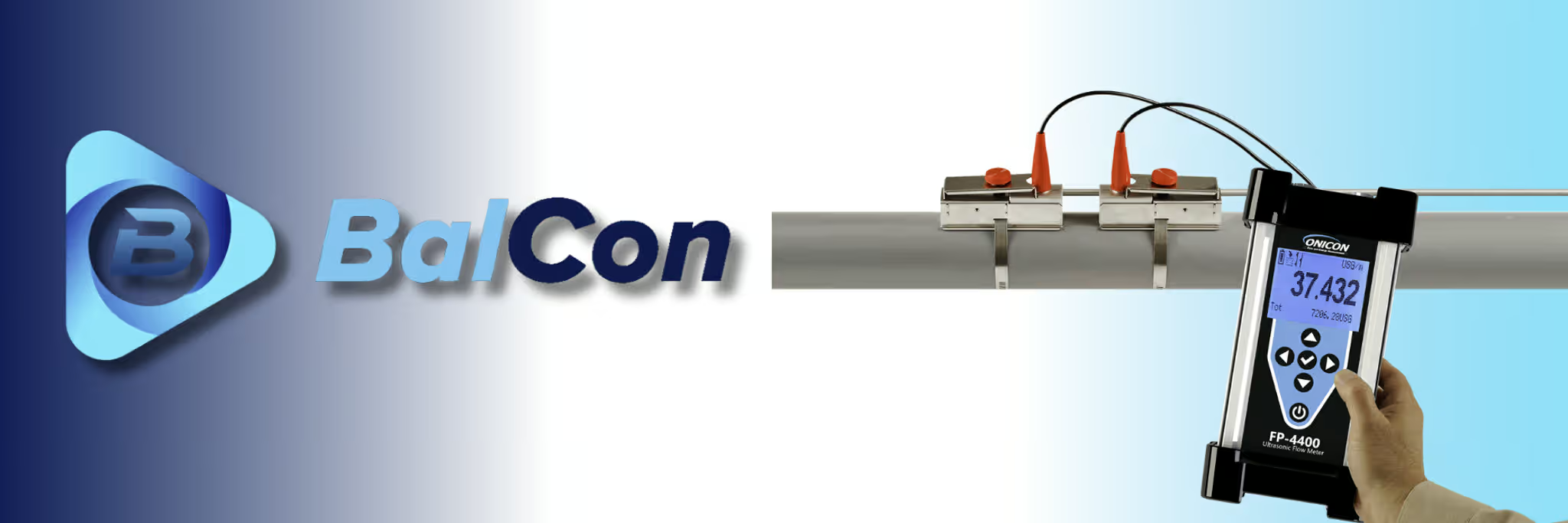
Measuring Flow Without Cutting Pipe: Ultrasonic Water Testing
Sometimes the pipe you need to measure has no flow meter, no balancing valve with ports, and no way to shut the system down. Clamp-on ultrasonic flow measurement solves exactly that problem. Two transducers strap to the outside of the pipe, send sound pulses through the wall and the moving water, and calculate flow from the timing. No cutting, no welding, no draining, and no added pressure drop.
How It Works
The main method is called transit-time, and the idea is the same as a swimmer in a river: swimming with the current is faster than fighting it. The meter fires one sound pulse downstream and one upstream. Moving water speeds the first one up and slows the second one down. That tiny time difference reveals the water's velocity, and velocity times the pipe's cross-section gives gallons per minute. Nothing touches the fluid — no moving parts, nothing to wear out or foul.
Done right, a clamp-on reading is typically accurate to within a percent or two of actual flow — tight enough that these meters are routinely used to check other flow meters.
Why It Belongs In A TAB Kit
· No shutdown, no penetration. One technician can strap a portable unit onto pipe from ½ inch to 48 inches — steel, copper, PVC, HDPE, fiberglass — and be reading flow in minutes.
· Independent verification. On a balance, that means confirming a circuit setter's calculated flow with a completely separate reading — or settling an argument about what the building automation system is really seeing. When two instruments that share nothing agree, the number is defensible.
· Trend data, not just spot checks. Portable units carry serious data logging — one common TAB model stores 12 million points. Leave the meter on a riser for a week and it captures the load profile a single reading would miss. That's ideal for baselining real demand during a building survey, or catching a pump that only misbehaves at night.
Getting A Reading You Can Trust
The meter is only as good as its setup. A few habits separate a defensible number from an expensive guess:
· Enter the pipe correctly. The meter calculates flow from the pipe's inside area, so it needs the actual diameter, wall thickness, and material — not a guess. A wall-thickness error carries straight through to the GPM. Lined pipe is a special trap: enter the liner too.
· Pick a good spot. The transducers want smooth, settled flow — the general rule is roughly ten pipe diameters of straight run upstream and five downstream, away from elbows, valves, and pumps. Mount on the side of a horizontal pipe (the 3 or 9 o'clock position), never the top or bottom: air collects at the top and sediment at the bottom, and both scatter the signal.
· Prep the surface. The sound has to get from the transducer into the pipe wall, which means clean metal and a layer of coupling gel. Flaking paint, rust scale, or insulation left in the way will kill the signal before the water ever sees it.
· Know your fluid. Sound travels at different speeds through different liquids. Plain water is the default; a glycol mix or hot condensate needs the right fluid properties entered, or the velocity math is quietly wrong.
Garbage parameters in, garbage GPM out — but with fifteen minutes of care, the number holds up.
The Honest Limitations
Transit-time needs a reasonably clean liquid path. Heavy air bubbles or suspended solids scatter the sound and degrade the reading. Hybrid meters answer that by switching automatically to the Doppler method, which works the opposite way — it relies on particles and bubbles to bounce sound off. Clean water, transit-time; dirty water, Doppler. Between the two, almost any hydronic system is measurable.
Where It Shines
Retrofit and troubleshooting work on systems that were never built to be measured. When there's no port to read and no shutdown to be had, clamp-on ultrasonic turns an unmeasurable pipe into a defensible number in under an hour.